There is a special kind of focus that is hard to capture through standard closed-eye meditation: thoughts scatter, the body fidgets, and attention slips away to a to-do list. Sometimes, your gaze and mind need a focal point rather than emptiness — a living object to hold your attention. A chakra candle provides exactly that kind of anchor.
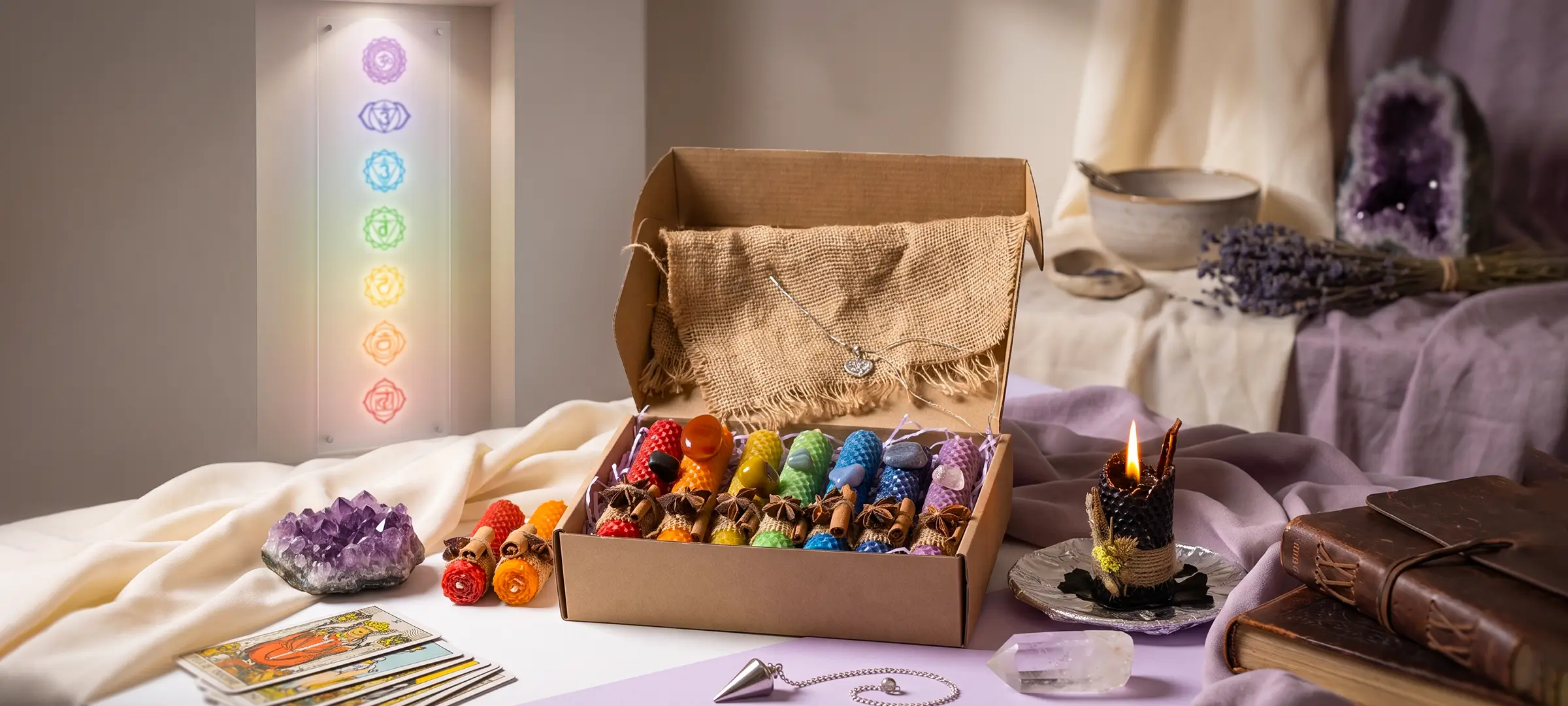
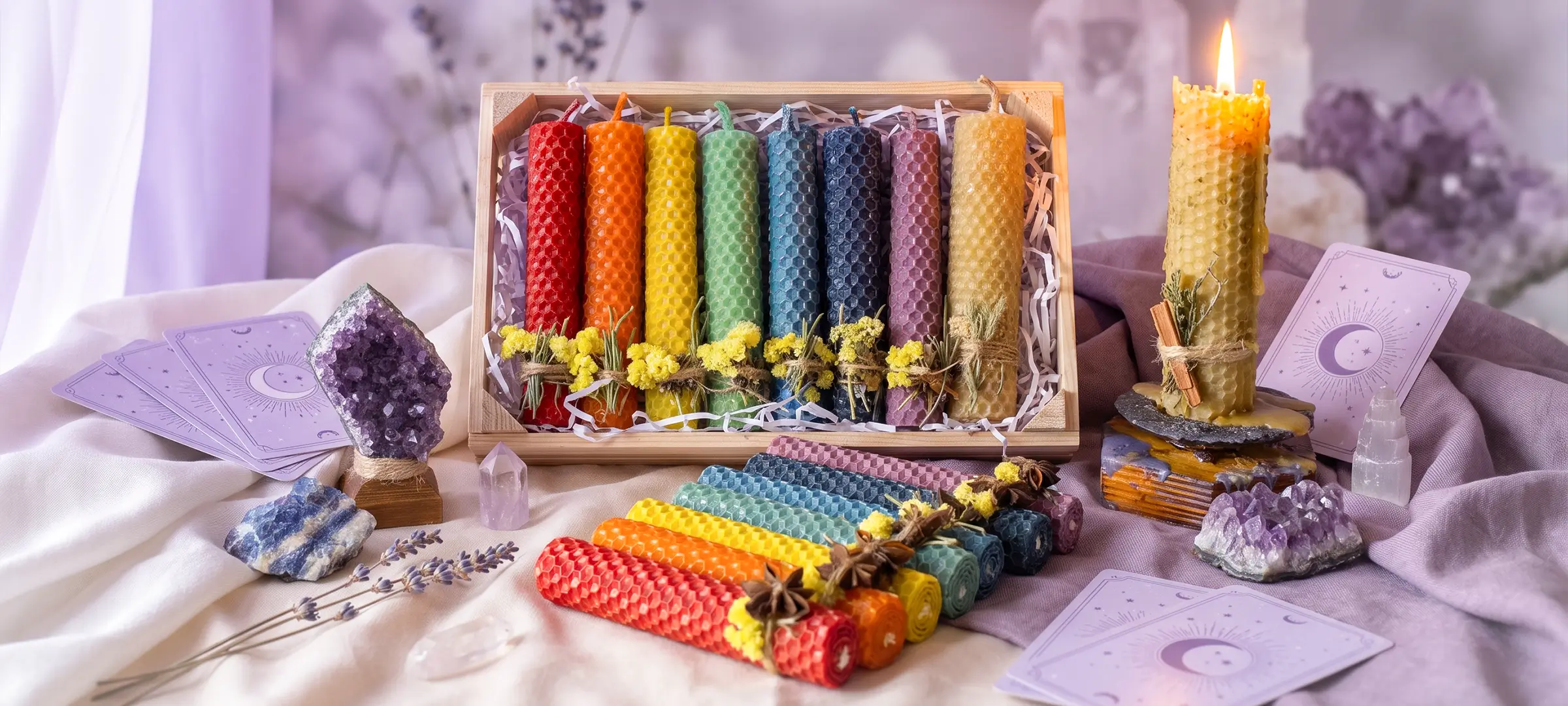
You can work with a single candle targeted at a specific chakra, or you can build a complete eight-day cycle. In this practice, each day is dedicated strictly to one energy center: on the first day, you light the red candle for the first chakra (Muladhara); on the second day, the orange candle for the second chakra (Svadhisthana); and so on, day by day, up to the seventh chakra (Sahasrara), represented by a purple candle. The sequence must not be changed — movement goes strictly from bottom to top along the chakra column. On the eighth day, a large candle is used for overall harmonization of the entire energy system.
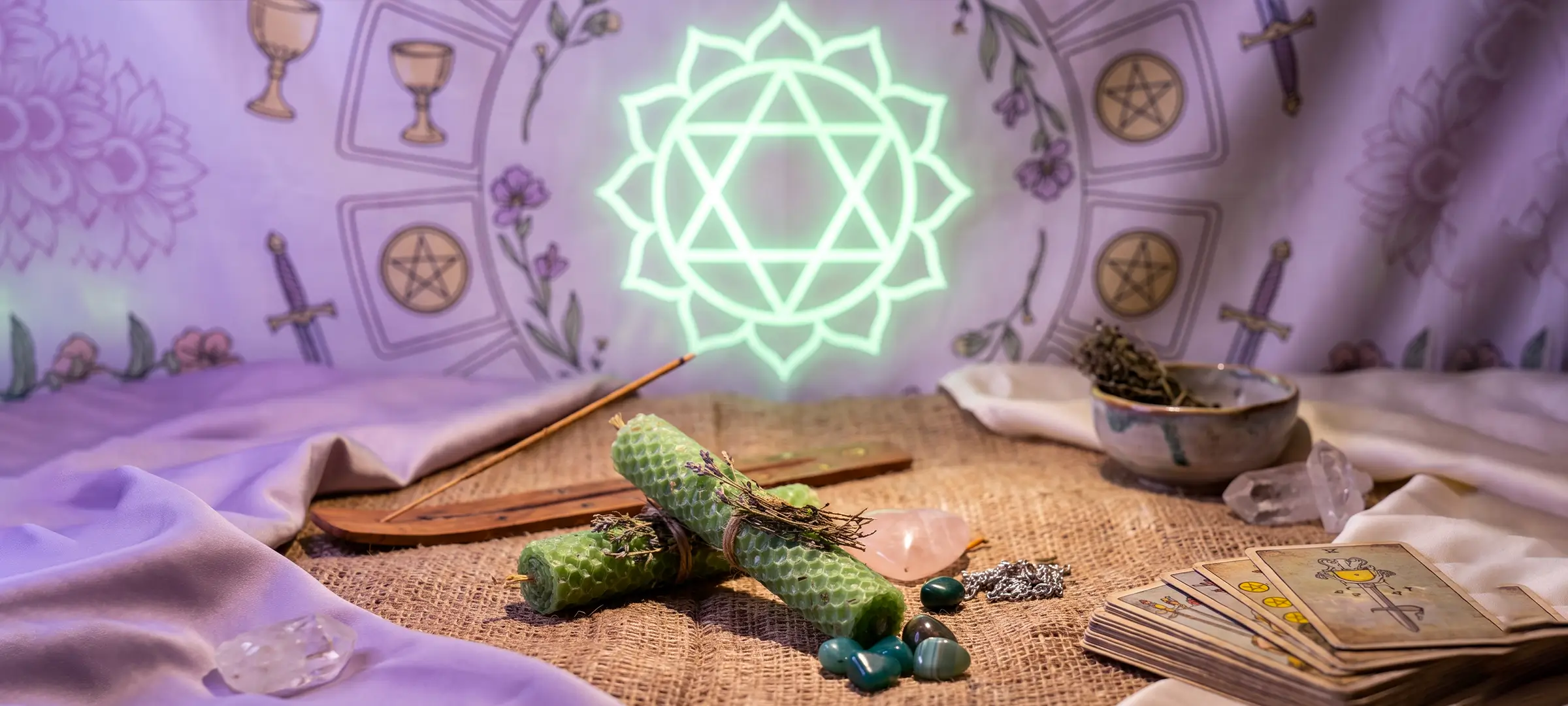
From a physiological perspective, a specific and well-studied mechanism is at work here — the ancient yogic practice of trataka (Sanskrit for «gazing»), a meditation technique based on fixing one's gaze on a candle flame.
The mechanism is simple: when your gaze fixes on a single point, thoughts stop racing because your eyes have no physical visual input to trigger new chains of associations. Attention that is normally scattered gathers at one point — creating a deep sense of presence and concentration. You can enhance the effect using the box breathing technique (4-second inhale — 4-second hold — 4-second exhale), synchronized with gazing at the flame.
⚠️ If you have vision conditions or diagnosed epilepsy, practice fixing your gaze on a flickering flame only after consulting a healthcare professional — it is not a universally suitable practice for all conditions.
🎯 To work on a specific request (for example: self-doubt — Manipura; difficulty expressing yourself — Vishuddha; closedness in relationships — Anahata — and similarly for other chakras based on their qualities).
⚡ As a regular practice to boost overall energy tone.
🗓️ As part of an eight-day cycle — when you want to systematically move through all energy centers and conclude with a full-system harmonization.
You can use these examples as a guideline (remembering that you choose the exact number of days — whether one, three, or five, depending on your inner response):
🫨 Anxiety and loss of stability — work with Muladhara (for example, three days to ground yourself);
💔 Relationship difficulties and emotional closedness — practice with Anahata (for example, five days for gentle opening);
🧘♀️ Seeking clarity and insight — focus on Ajna (for example, two or three days for inner quiet).
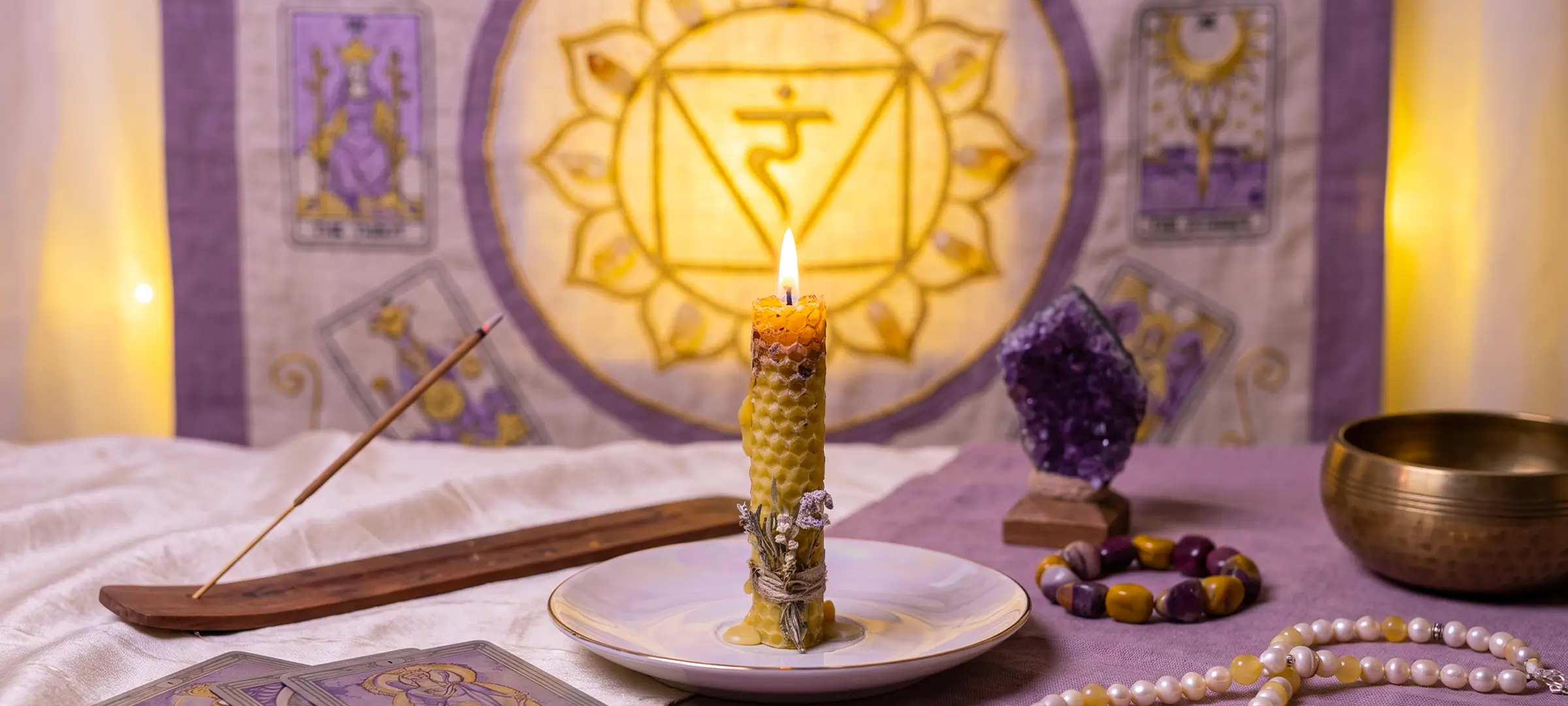
Place the candle on a candle holder. Since chakra candles burn evenly via the wick without heavy smoke or flaring, a standard tray or holder with raised edges is sufficient. Use a match to light the wick, then position yourself so the flame is directly at eye level (level with the bridge of your nose or eyes so your neck remains relaxed and your gaze falls straight and naturally), about half a meter away.
Keep your gaze on the flame, but remember that in candle-gazing practices like traditional trataka, it is essential to maintain a natural rhythm, blink normally, and protect your eyes rather than straining them to tears. Begin with 5–10 minutes. Over time, you can extend the practice (for example, 20–40 minutes or even an hour works very well).
When your session is complete, if you feel tired, or if you need to stop, extinguish the candle with a snuffer and relight it next time to continue your work. Mindfulness and fire safety come first. For details on candle holders, trays, and safety rules, visit Safety and Holders →
Reality: The mechanism of concentrating on a flame functions regardless of how deeply you understand the chakra system — trataka as a focus technique works on the level of sensory physiology.
✕ Myth: The longer you stare at the candle, the stronger the effect.
Reality: Consistency matters more than session length — 5–10 minutes daily is far more effective than an hour once a month.
✕ Myth: If you don't feel anything immediately, the practice isn't for you.
Reality: Focus is a trainable skill. The first few sessions may feel like simply «sitting in front of a candle», and that is completely normal.
For more common misconceptions about ritual candles, read our main article Candle Myths →
Where did the system of seven chakras with these specific colors come from? The idea of energy centers originated in Hindu and Buddhist tantric traditions, while the familiar system of seven chakras with specific colors was systematized by theosophist Charles Leadbeater in his book «The Chakras» (1927) — a later Western interpretation of the ancient concept.
How does a chakra candle differ from a harmonizing candle? A harmonizing candle works with the overall background energy of a space, while a chakra candle focuses on a specific energy center through the practice of flame concentration. Learn more in Harmonizing Candles →
Do I need special preparation before practicing with a chakra candle? No, a quiet place and a few free minutes are enough. To enhance the effect, you can synchronize your gaze on the flame with simple 4-count breathing.
Is gazing at the flame safe for the eyes? For most people, yes, but if you have vision issues or diagnosed epilepsy, it is better to consult a doctor beforehand.
Can I use a chakra candle alongside a Tarot reading? Yes, they pair very well — the candle helps maintain focus on a specific topic raised during the reading during subsequent meditation. Try a spread at Online Tarot Reading →
How long does a practice session with one candle last? Start with 5–10 minutes, focusing on your comfort level.
What should I do if my eyes water during the practice? This is a normal reaction when focusing your gaze on a flame — in the trataka tradition, it is considered part of the cleansing process. If the discomfort is strong, blink more frequently or shorten the session time.
Is there scientific evidence supporting the benefits of such meditation? Yes — a study by Chowdhary (2015) recorded a significant increase in concentration and memory among those practicing trataka over an 8-week period.
👉 View and choose chakra candles in the store 🛍️ →
If you prefer working with the general background of a space rather than a specific energy center, check out Harmonizing Candles, or read How to Choose a Candle → to help make your choice.
All about designer, ritual candles →
This is one of the directions of the Beeswax Sheets Candles section — covering the tradition and physics of meditative practice with fire, as well as how to choose and use a chakra candle for your specific intention.
What's Inside a Chakra Candle 🕉️
Each chakra candle is handcrafted from natural colored beeswax sheets corresponding to a specific energy center. Additionally, its composition can be enriched with herbs, spices, and essential oils aligned with the vibrations of that particular chakra:| Chakra | Color | Ingredients (Example) | Energy Work | Psychological Meaning |
|---|---|---|---|---|
| Muladhara (Root) | Red | Patchouli, sandalwood, ginger | Grounding, sense of support | Basic feeling of security, stability in times of crisis |
| Svadhisthana (Sacral) | Orange | Orange, ylang-ylang | Sensuality, creative flow | Allowing oneself pleasure, creative freedom |
| Manipura (Solar Plexus) | Yellow | Lemon, ginger | Willpower, confidence, personal power | Locus of control — feeling that decisions depend on you |
| Anahata (Heart) | Green/Pink | Rose, bergamot | Acceptance, openness, love | Ability to invite intimacy without closing off after pain |
| Vishuddha (Throat) | Light Blue | Eucalyptus, mint | Self-expression, honesty in speech | Ability to express boundaries and speak uncomfortable truths |
| Ajna (Third Eye) | Indigo | Lavender, clary sage | Intuition, clarity of mind | Trusting your perception, reducing intrusive doubts |
| Sahasrara (Crown) | Violet/White | Frankincense, sandalwood | Wholeness, connection to something greater | Sense of purpose and belonging to something beyond oneself |
You can work with a single candle targeted at a specific chakra, or you can build a complete eight-day cycle. In this practice, each day is dedicated strictly to one energy center: on the first day, you light the red candle for the first chakra (Muladhara); on the second day, the orange candle for the second chakra (Svadhisthana); and so on, day by day, up to the seventh chakra (Sahasrara), represented by a purple candle. The sequence must not be changed — movement goes strictly from bottom to top along the chakra column. On the eighth day, a large candle is used for overall harmonization of the entire energy system.
💡 Important: Candles are available individually or as complete sets — view in the candle shop →
Where the Chakra System Came From 📜
The history of energy centers is rooted in Hindu and Buddhist tantric traditions. However, the system of seven chakras with fixed colors familiar to us today is a later adaptation tailored to Western thinking. British theosophist Charles Leadbeater systematized it in his book «The Chakras» in 1927. This work largely shaped the modern version of the system used today in creating chakra candles and guided flame meditations.The Tradition and Physics of Focus 🔥
Chakras are subtle energy centers, intersection points of subtle energy channels (nadis) through which vital force (prana) circulates. In traditional systems, they relate not only to specific tasks, but also to levels of consciousness, elements, sensory organs, and psychological states. Based on this, the color and composition of each candle are selected to support the intended energy center and restore balance.From a physiological perspective, a specific and well-studied mechanism is at work here — the ancient yogic practice of trataka (Sanskrit for «gazing»), a meditation technique based on fixing one's gaze on a candle flame.
💡 Important: Clinical and experimental studies show that participants practicing trataka for 20 minutes a day over 8–12 weeks demonstrated significant improvements in attention span, working memory, and cognitive control (Swathi et al., 2021; review of experimental protocols in the Journal of Neurosciences in Rural Practice, 2025).
The mechanism is simple: when your gaze fixes on a single point, thoughts stop racing because your eyes have no physical visual input to trigger new chains of associations. Attention that is normally scattered gathers at one point — creating a deep sense of presence and concentration. You can enhance the effect using the box breathing technique (4-second inhale — 4-second hold — 4-second exhale), synchronized with gazing at the flame.
⚠️ If you have vision conditions or diagnosed epilepsy, practice fixing your gaze on a flickering flame only after consulting a healthcare professional — it is not a universally suitable practice for all conditions.
When to Use the Candles 🕯️
🧠 When standard closed-eye meditation feels unstable and your thoughts wander.🎯 To work on a specific request (for example: self-doubt — Manipura; difficulty expressing yourself — Vishuddha; closedness in relationships — Anahata — and similarly for other chakras based on their qualities).
⚡ As a regular practice to boost overall energy tone.
🗓️ As part of an eight-day cycle — when you want to systematically move through all energy centers and conclude with a full-system harmonization.
Short Scenarios for Your Request (If You Don't Want to Complete the Full Cycle) 🎯
In authentic traditions — for instance, in the teachings of Sadhguru (Jaggi Vasudev, a well-known contemporary yogi and spiritual teacher) — there are no artificial calendars or strict rules prescribing a fixed number of days. You can choose to conduct a one-day practice to harmonize whichever chakra resonates with you right now, or dedicate several days to it. Everything depends entirely on your personal perception, awareness, resonance, and intention.You can use these examples as a guideline (remembering that you choose the exact number of days — whether one, three, or five, depending on your inner response):
🫨 Anxiety and loss of stability — work with Muladhara (for example, three days to ground yourself);
💔 Relationship difficulties and emotional closedness — practice with Anahata (for example, five days for gentle opening);
🧘♀️ Seeking clarity and insight — focus on Ajna (for example, two or three days for inner quiet).
How to Light and Meditate Correctly ✅
Start by tuning in to the practice: find a quiet space, take a few deep breaths in and out to calm your mind and shift from daily hustle into a state of presence. If you prefer, play soft background music — tracks tuned to specific energy centers (chakras) are available on platforms like YouTube Music. The key is to choose appropriate sound vibrations rather than a random track.Place the candle on a candle holder. Since chakra candles burn evenly via the wick without heavy smoke or flaring, a standard tray or holder with raised edges is sufficient. Use a match to light the wick, then position yourself so the flame is directly at eye level (level with the bridge of your nose or eyes so your neck remains relaxed and your gaze falls straight and naturally), about half a meter away.
Keep your gaze on the flame, but remember that in candle-gazing practices like traditional trataka, it is essential to maintain a natural rhythm, blink normally, and protect your eyes rather than straining them to tears. Begin with 5–10 minutes. Over time, you can extend the practice (for example, 20–40 minutes or even an hour works very well).
When your session is complete, if you feel tired, or if you need to stop, extinguish the candle with a snuffer and relight it next time to continue your work. Mindfulness and fire safety come first. For details on candle holders, trays, and safety rules, visit Safety and Holders →
Chakra Candle vs. Harmonizing Candle: What's the Difference ⚖️
Both burn smoothly and cleanly via the wick, but their purposes differ: a harmonizing candle acts on the overall ambiance of a space and mood, while a chakra candle targets a specific energy center through focused flame meditation. If your goal is to «balance home atmosphere», choose harmonizing candles; if your goal is to «work on a specific issue through focus and meditation», use chakra candles.From My Practice 📖
A client came for a consultation with a common challenge: «I understand everything about myself, but I can't say it out loud — it feels like my throat closes up». Along with the reading, we incorporated a practice using the light blue Vishuddha candle — five minutes of flame focus every evening for a week. A few days later, she shared that at work she was able to calmly voice a disagreement to her manager where she previously would have stayed silent.Myths About Chakra Candles ❌
✕ Myth: Without deep esoteric knowledge, chakra practices won't work.Reality: The mechanism of concentrating on a flame functions regardless of how deeply you understand the chakra system — trataka as a focus technique works on the level of sensory physiology.
✕ Myth: The longer you stare at the candle, the stronger the effect.
Reality: Consistency matters more than session length — 5–10 minutes daily is far more effective than an hour once a month.
✕ Myth: If you don't feel anything immediately, the practice isn't for you.
Reality: Focus is a trainable skill. The first few sessions may feel like simply «sitting in front of a candle», and that is completely normal.
For more common misconceptions about ritual candles, read our main article Candle Myths →
Frequently Asked Questions About Chakra Candles and Meditation ❓
Is it necessary to buy a set of eight candles, or can I get just one? You can start with a single candle for a specific intention — the set is useful if you want to systematically work through all centers over eight days.Where did the system of seven chakras with these specific colors come from? The idea of energy centers originated in Hindu and Buddhist tantric traditions, while the familiar system of seven chakras with specific colors was systematized by theosophist Charles Leadbeater in his book «The Chakras» (1927) — a later Western interpretation of the ancient concept.
How does a chakra candle differ from a harmonizing candle? A harmonizing candle works with the overall background energy of a space, while a chakra candle focuses on a specific energy center through the practice of flame concentration. Learn more in Harmonizing Candles →
Do I need special preparation before practicing with a chakra candle? No, a quiet place and a few free minutes are enough. To enhance the effect, you can synchronize your gaze on the flame with simple 4-count breathing.
Is gazing at the flame safe for the eyes? For most people, yes, but if you have vision issues or diagnosed epilepsy, it is better to consult a doctor beforehand.
Can I use a chakra candle alongside a Tarot reading? Yes, they pair very well — the candle helps maintain focus on a specific topic raised during the reading during subsequent meditation. Try a spread at Online Tarot Reading →
How long does a practice session with one candle last? Start with 5–10 minutes, focusing on your comfort level.
What should I do if my eyes water during the practice? This is a normal reaction when focusing your gaze on a flame — in the trataka tradition, it is considered part of the cleansing process. If the discomfort is strong, blink more frequently or shorten the session time.
Is there scientific evidence supporting the benefits of such meditation? Yes — a study by Chowdhary (2015) recorded a significant increase in concentration and memory among those practicing trataka over an 8-week period.
Choose Your Candle 🕯️
The chakra candles in this section are handcrafted from colored beeswax honeycomb sheets with herbs and essential oils tailored to each energy center — available individually or as a complete set for an eight-day practice. If you feel drawn to working with focus, attention, and a specific energy center right now, start here.👉 View and choose chakra candles in the store 🛍️ →
If you prefer working with the general background of a space rather than a specific energy center, check out Harmonizing Candles, or read How to Choose a Candle → to help make your choice.
All about designer, ritual candles →